Progress — 0%
About this tool
ALS (amyotrophic lateral sclerosis) is a disease that weakens the muscles we use to move, swallow, and breathe. ALS can also cause changes in the way people think and act. Learn the basics about ALS.
People living with ALS have trouble breathing on their own. As ALS weakens the muscles in your chest, it will become harder for you to breathe. Your ALS care team may call this “respiratory muscle weakness,” and it progresses (gets worse) over time.
Breathing support options for people living with ALS
Everyone’s experience with ALS is different — and treatment looks different for everyone, too. Your ALS care team can recommend breathing support options based on your unique needs and preferences.
One option is called non-invasive ventilation (NIV): ventilators that pump air through a mask that you wear on your face. These devices are called “non-invasive” because they don’t go inside your body. Some people living with ALS try NIV first — but as respiratory muscle weakness progresses, NIV may not provide enough breathing support. Plus, some people prefer not to use NIV. Learn more about NIV for people living with ALS.
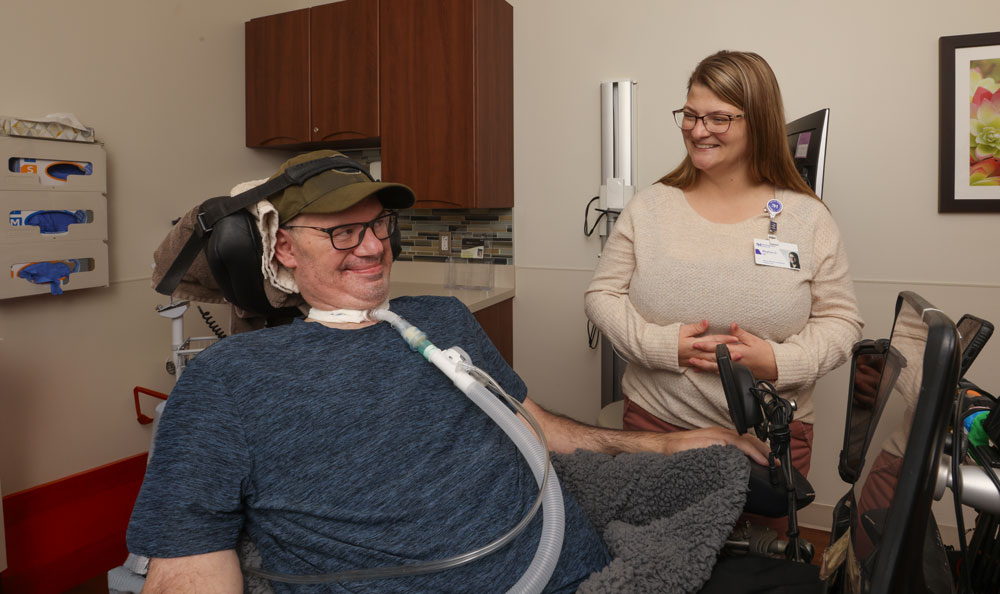
Another option is a tracheostomy tube, or trach for short. A trach provides a higher level of breathing support than NIV. It’s a small plastic tube that sits in your trachea (windpipe). You will need to have surgery to have the tube placed in your windpipe. The tube allows air to move directly into your lungs instead of passing through your nose, mouth, or vocal cords. Using a trach can also help to keep materials like food, liquids, and saliva (spit) from passing into your lungs by mistake.
Most people living with ALS who use a trach also use invasive mechanical ventilation (IMV). This means you will have a ventilator connected to your trach to provide additional breathing support.
How this tool can help
You can use this tool to learn more about using a trach and IMV and talk to the important people in your life about your options.
Using a trach and IMV can help you breathe and keep your lungs clear — so you can live longer and spend more time with the people you love. But it’s important to understand that using a trach and IMV will bring big changes to your daily life, and you will need support from caregivers 24 hours a day. This tool will help you understand what to expect, so you can talk to others about your needs and preferences.
You can use this tool to start the conversation about trach and IMV with your loved ones — or even ask them to go through the tool with you. Then, talk to your ALS care team to make a treatment plan that works for you.