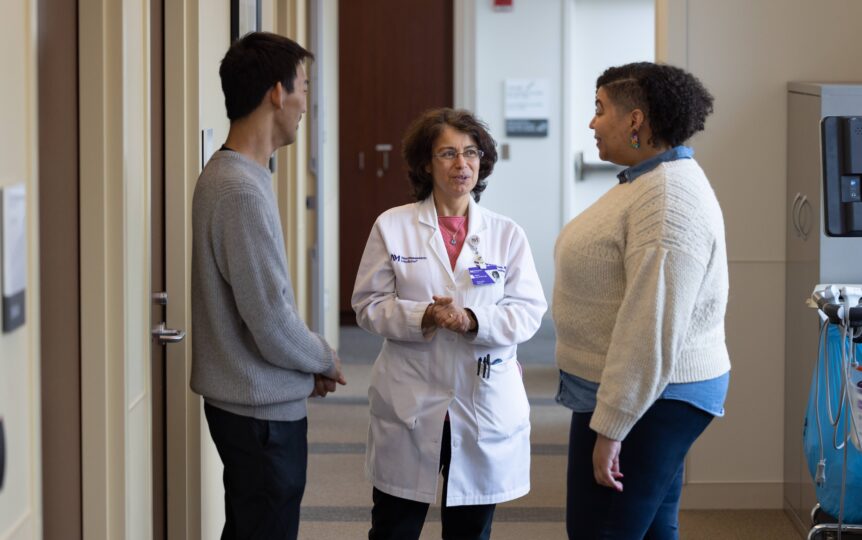
As director of the clinical research program at the Les Turner ALS Center at Northwestern Medicine, Senda Ajroud-Driss has seen her share of potential ALS therapies.
Though many drugs have not made it past clinical trials, recent advances have given her team hope.
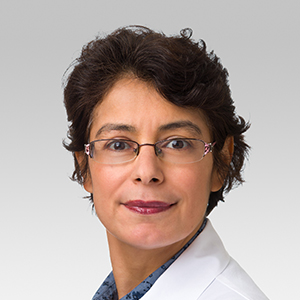
Senda Ajroud-Driss, MD, Neurology
“Scientists understand targets better and are designing drugs that are more selective than they used to be,” said Ajroud-Driss, who is also a professor of neurology at Northwestern and the director of the Lois Insolia ALS clinic at Northwestern Medicine. “We have learned from every single clinical trial, and we are better at the science of ALS for it.”
One category of new therapies is called antisense oligonucleotides (ASOs), which target RNA within the body to change protein expression. “By stopping messenger RNA from making proteins, ASOs decrease the level of that protein and hopefully restore motor neuron function or stop other motor neurons from dying,” Ajroud-Driss said.
By directly aiming at the source of disorders, ASOs have been successful in treating genetic diseases such as spinal muscular atrophy, a disease that causes muscles to become weak and waste away. Patients with the disease showed improved motor function when treated with ASOs.
In 2023, the FDA provided conditional approval for Tofersen, an ASO for ALS patients with the SOD1 gene mutation. Northwestern was part of the clinical trial that led to that approval. “It was the first time we had a really targeted treatment for familial ALS, and it was successful,” Ajroud-Driss said.
Now, Northwestern is part of another clinical trial program for an ASO that will treat ALS patients who have the CHCHD10 gene mutation. Working with researchers at Columbia University and the n-Lorem Foundation, the Les Turner ALS Center is testing the treatment on patients in the Midwest.
When patients are enrolled in the trial, they receive an injection of the ASO into the intrathecal space via a spinal tap. Physicians monitor the patients to ensure safety, and along the way, they test for biomarkers in the patients’ blood and spinal fluid to understand how the treatment is affecting the disease.
“Our hope is that this small clinical trial will prove that the drug is safe and will lead to a larger trial that will focus on its efficacy,” Ajroud-Driss said.
“The therapeutic approach (administration of ASOs to target specific genes in individuals with familial ALS) has great potential for a small, specific subpopulation of ALS patients,” said Robert Kalb, MD, director of the Les Turner ALS Center at Northwestern Medicine. “At present there is no evidence that ASO targeting SOD or CHCHD10 in individuals with sporadic disease is indicated. Basic science research into mechanisms common to all ALS patients may lead to new targets that could be zapped by ASOs.”
The center is also a site for the Healey Platform and MyMatch trials, an innovative trial design that is meant to speed up drug discovery. “Over the past six years, we’ve had results on several drugs that were tested through the platform trials,” Ajroud-Driss said.
In addition, the center is involved in many observational trials, where physicians collect patient data—including blood and spinal fluid—to help them understand the disease better.
The Les Turner ALS Foundation has had a consistent and longstanding commitment to the clinical research program and helps fund the infrastructure for these clinical trials. This allows the center to retain staff who can implement new trials as they become available.
“It’s really important to have the foundation behind our clinical research program,” Ajroud-Driss said. “The funding ensures we don’t have any disruption, which is important as new therapies for ALS are ready to be tested.”
