
Lace Up for a Cause at the Lew Blond Run/Walk
Join us on Saturday, May 18 for the Lew Blond Memorial 5K Run/Walk — a community tradition that honors the life and legacy of beloved Maple School teacher Lew Blond, who passed away from ALS in 2000.
Held in Northbrook’s Maple School neighborhood, the race draws more than 700 participants and volunteers annually. Proceeds support ALS research through the Les Turner ALS Foundation, scholarships for future educators at Glenbrook High Schools, and local school district projects.
Whether you’re a seasoned runner or looking for a fun family outing, this event is a meaningful way to support people living with ALS — and remember an extraordinary educator.
When you register, make sure to tick the box that indicates you heard about the Lew Blond Run through Les Turner ALS Foundation — this ensures 100% of the proceeds go to support our mission.
Sign up today and be part of a community making a difference, one step at a time.
Navigating SSDI with ALS: What You Need to Know

Applying for Social Security Disability Insurance (SSDI) can be confusing — especially when you’re also managing an ALS diagnosis. Our latest article breaks down three key tips to help streamline the process and avoid common pitfalls.
Thanks to the ALS Disability Insurance Access Act of 2019, people living with ALS no longer have to wait five months to receive SSDI benefits. But there are still important steps to take — from ensuring your diagnosis is clearly stated in your application to checking in regularly with the Social Security Administration.
If you’re running into delays or need help navigating the process, your Les Turner ALS Foundation Support Services Coordinator is here for you.
Click this link to read the full article:
May ALS Learning Series

Join us live on Friday, May 16 at 12 p.m. CST for Breaking Barriers: Building a Health Equity Approach to Make ALS Livable for All, part of our ALS Learning Series.
Led by Dr. Chelsey R. Carter of Yale University, this session explores how social and structural determinants affect ALS outcomes — and how we can build more inclusive, equitable care models. Dr. Carter will highlight current research initiatives, disparities in ALS care, and ways to better support individuals, caregivers, and families.
This program is available at no cost to the ALS community thanks to the Gilbert & Jacqueline Fern Foundation and Mitsubishi Tanabe Pharma America.
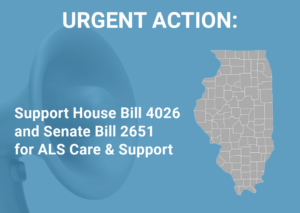
House Bill 4026 and Senate Bill 2651 could bring critical funding to ALS care and research in Illinois — but it needs your support to move forward.
Filed by State Rep. Kevin Olickal and State Sen. Ram Villivalam, respectively, these bills would expand access to vital services for people living with ALS. You can help by contacting your state legislators today. It only takes a minute — use our easy form and pre-written message, or share your own ALS story to make an even stronger impact.
Together, we can make sure the needs of the ALS community are heard in Springfield. Voice your support by clicking this link:
ALS Drug NU-9 Shows Promise for Alzheimer’s in New Study

A groundbreaking Northwestern University study reveals that NU-9, a drug developed to treat ALS, also shows potential in treating Alzheimer’s disease. The experimental compound, which has already received FDA approval for ALS clinical trials, improves neuron health and reduces toxic protein buildup in Alzheimer’s animal models.
Rather than targeting symptoms, NU-9 addresses shared disease mechanisms, offering hope for broader neurodegenerative treatment strategies. “This drug is quite remarkable that it works in these multiple systems,” said Dr. Richard Silverman, one of the inventors of NU-9 and a member of the Les Turner ALS Center at Northwestern Medicine.
The findings suggest NU-9 may open the door to therapies that can treat multiple brain diseases at their root.
Read the full article at this link:


