Terri Tatroe doesn’t waste time on despair. At 65, the Coal City mother of three and grandmother of five has already checked off her number-one bucket list item — a trip to Bali, Indonesia, to see her youngest son and his two children.
“I’m going to be rolling with ALS,” she laughs, already planning how her husband will fit a wheelchair into their SUV for the ALS Walk for Life. It’s the kind of practical optimism that runs in her family — and in her genes.
The family knows ALS all too intimately. Terri’s father passed away from the disease in 1987, just 13 months after diagnosis and one month after her son’s first birthday. Two of his cousins — a brother and sister — also had ALS. Her uncle had Parkinson’s with ALS symptoms, and her aunt had what they now believe was FTD. Her paternal grandmother carried the gene but never developed the disease.
Last November, Terri woke up and couldn’t hook her bra. Her right thumb had lost its strength. She dismissed it — there were holiday decorations to hang, a son and grandkids coming to visit. By mid-December, the weakness persisted. She’d had a fall, so she didn’t know if it was cervical or something worse. “I never had any symptoms prior to that,” she says. “Not that I was aware of.”
She told her kids she’d see a neurologist after the holidays. On January 5, a beautiful winter day, her husband was taking down the Christmas lights. She went to help. When she came inside to wash her hands, they were completely stiff. “I could hardly move them. I told my husband, ‘There’s something going on.'”
Within 10 days, she was at Loyola University Medical Center. An EMG followed. On a Friday morning, the doctor called with the diagnosis. She and her husband had a “little cry fest,” then gathered the kids on Zoom. By 2 p.m., Terri had made a decision. “I said, ‘It is what it is. If God wants me to do this, I can do it.'”
By Monday, Loyola had referred her to Northwestern. The Les Turner ALS Foundation was already in the loop. Rochelle Walwer, LCSW, her support services coordinator, called that same day. “Everything came together pretty quickly.” At her first appointment, Terri told Dr. Robert Kalb that her sister had just tested positive for the C9ORF72 gene mutation. Genetic testing was planned immediately.
“I have the C9ORF72 gene mutation,” Terri says. “My sister has FTD, and my other sister died of supranuclear palsy, which is also attached to that gene mutation.” Two other siblings are participating in research programs at different universities. With 12 siblings and roughly 120 cousins, the stakes feel enormous. “You’re talking about a significant number of people within one family. All the things we can do about this gene mutation for future generations are important.”
When asked how her father’s journey shapes her own, Terri doesn’t hesitate. “I’m happy every day. That’s what I got from my dad. He was never negative, never thinking about what was going to happen in the future.”
Terri was already familiar with the Les Turner ALS Foundation. Back in 1986, the family drove to Skokie for counseling through the Foundation for her father’s diagnosis. These sessions were with Anne Lidsky, PhD, who is currently running the Foundation’s ALS Caregivers Support Groups. “I brought that counseling with me through my whole life,” Terri says.
Her father had no medications, no treatments — just someone to help him stretch, and his family. Two days after her son was born, he came directly from the Mayo Clinic with a confirmed diagnosis to take a photo with his new grandson. It was a month after her son’s first birthday that he passed away. This July marked 39 years.
When she received her own diagnosis, it was the first place she reached out to. That continuity — from her father’s counselor decades ago to Rochelle today — means everything. “Rochelle is a great sounding board,” Terri says. “She was pretty shocked when I told her how prepared I was for end-of-life things on our first call.”
But that’s Terri: proactive, not reactive. She’s not in a wheelchair yet, but she already has one ready, sourced through Team Gleason with the Foundation’s referral. She’s gotten equipment ahead of every need. At the Hope Through Caring Gala in April, she finally met Rochelle, Cara, and other members of the Support Services team in person. She sat at a table with fellow ALS community members, swapping stories.
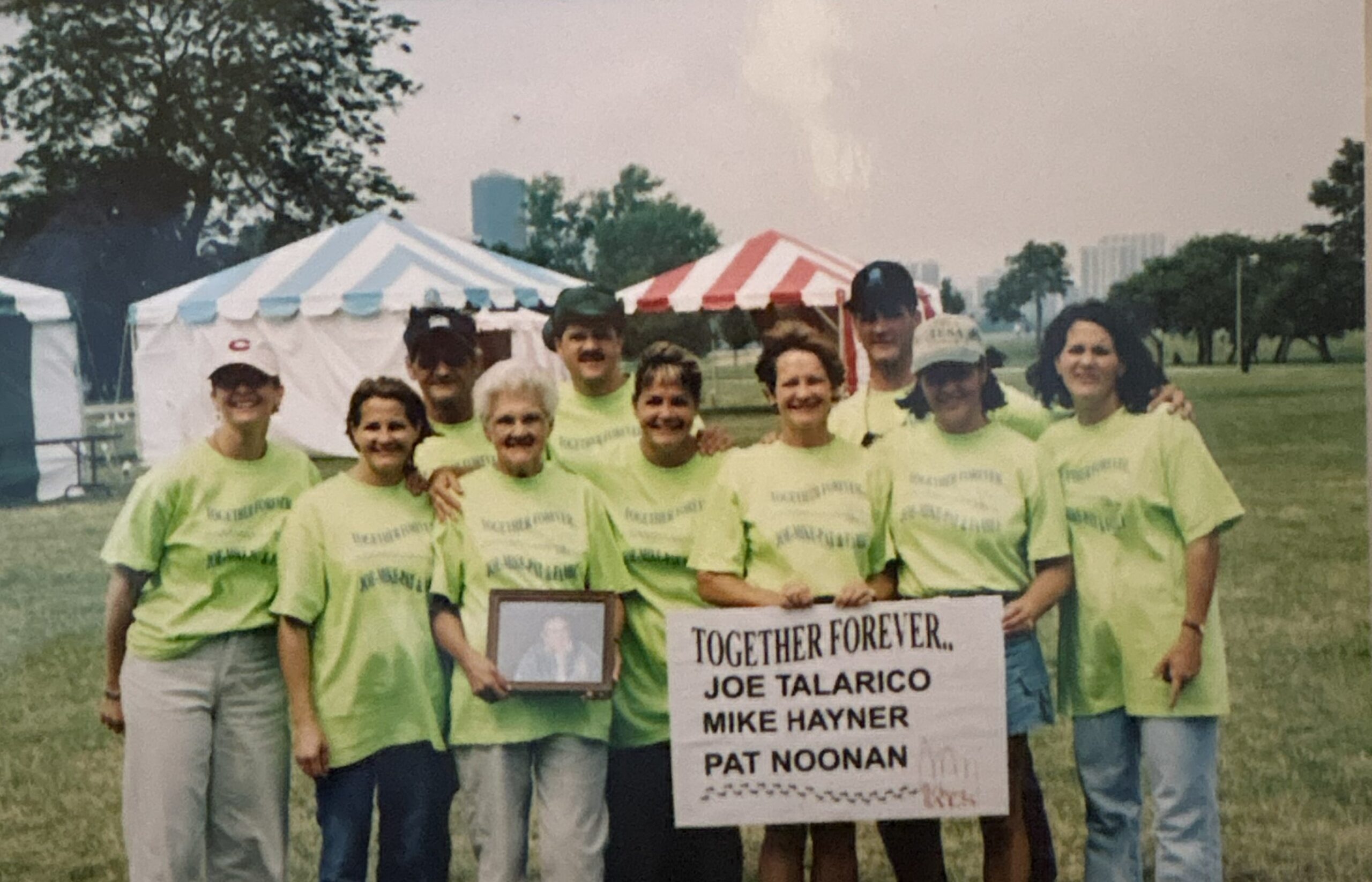
The Tallarico family at an early ALS Walk for Life.
Terri’s ALS Walk for Life team has already blown past its fundraising goal. “We were blessed to have my dad for as long as we did,” she says. “I treasured every day.” The family attended Walks over the years, then gathered again in 2014 to honor all three relatives they’d lost. This year will be different. “Now it will be emotional because it will be for me. It’s my journey.” Her former boss recently called. He was offering a couple thousand dollars, wanting to send Terri and her girlfriends away for a weekend trip. She told him to donate to the Walk instead.
At home, her husband of nearly 47 years has stepped into the caregiver role with tenderness and humor. “He’s trying his best at making food — he never was a kitchen guy, he was an eating guy,” Terri laughs. “We joke around a lot. If he’s doing something silly I ask him, ‘What, do you have ALS or something?'” Friends drop off frozen meals. He carries her trays outside to the deck, sets up the umbrella, and tells her to let him know when she’s ready. The kids play games with her. “Every day is different, but again it’s the same.”
Terri’s bucket list isn’t finished. There’s more adventures yet to be had — she and her husband are tent campers. There’s the Smoky Mountains, with family stops along the way. When she and her husband built their home 30 years ago, they made deliberate choices — master bathroom on the main floor, accessible layout — not knowing they’d need it, but ready. They’ve decided to stay and renovate.
Terri Tatroe isn’t waiting for a cure to live fully. She’s already doing it — one trip, one laugh, one Walk at a time. And when you ask her how she’s doing, she’ll tell you the truth with a smile: “I’m rolling with ALS.”