Researchers have long suspected the immune system to be a key player in the connective breakdown between the brain and the muscles in people with ALS.
At the Les Turner ALS Center at Northwestern Medicine, neuroimmunologist and assistant professor David Gate is putting this theory to the test. His investigation will not only improve our understanding of disease progression in ALS—it may uncover new therapeutic targets which can be used to develop groundbreaking treatments.
With funding from the Les Turner ALS Foundation, Gate and his team sequenced the DNA of every immune cell in blood samples from people with the inherited (genetic) and sporadic (non-genetic) forms of ALS. They also sequenced immune cells from healthy control patients.
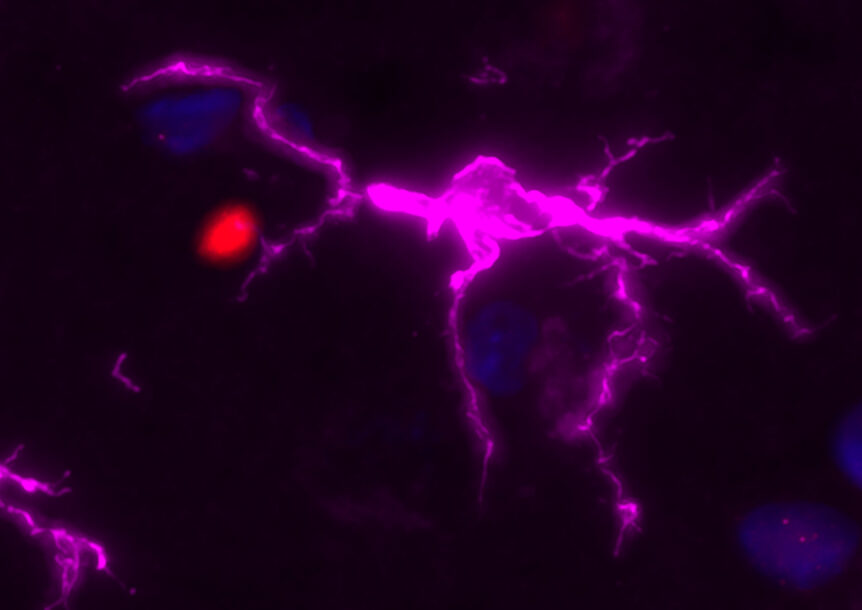
Gate’s team found that the profile of immune cells within the blood of ALS patients appeared to be in an “activated state,” which led them to test whether that same immune cell dysfunction was also present in the patients’ tissue.
To find out, they studied spinal cords of deceased patients using a technique called spatial transcriptomics. Aligning the tissue sections with RNA sequencing allowed Gate and his team to map immune system changes to motor neurons in the spinal cord.

David Gate, PhD, Neurology
“It’s really important to localize the inflammation with this tool, because in in ALS, the communication between the brain and spinal cord neurons is compromised, and we think that it’s partly due to immune cell inflammation in the spinal cord,” said Gate, who is an assistant professor of neurology and director of the Abrams Research Center on Neurogenomics at the Feinberg School of Medicine at Northwestern.
The research team found that the same kind of immune cells that were inflamed in the blood were also inflamed in the tissue. This finding suggests that the dysfunctional immune cells may originate in the spinal cord and then escape into the blood. Alternatively, or in addition, the immune response might start outside of the nervous system and then infiltrate the spinal cord.
Additionally, the team found more inflamed immune cells in areas that had toxic aggregation of the protein TDP-43—a hallmark of ALS. The team also found increased inflammatory molecules in ALS patients with more rapid disease progression.
“It was a really nice validation of our prior findings in the blood to show that immune system changes are likely involved in the disease,” Gate said.
Identifying the specific genes and molecules of immune cells involved in ALS allows scientists to design targeted therapies that reduce inflammation in patients. Gate and his team have already had interest from pharmaceutical companies hoping to develop a new therapy targeting the immune system.
“We don’t think the immune system causes the disease, but we think it makes it worse,” Gate said. “A therapy that helps mitigate the inflammatory response should help ALS patients.”
“This work is a highly sophisticated interrogation of the immune system-nervous system interface and might have therapeutic implications,” said Robert Kalb, MD, director of the Les Turner ALS Center at Northwestern Medicine.
Next, the team will examine the motor circuits of ALS patients—that is, the motor cortex of the brain, the spinal cord, and the muscle. Together, these tissue samples give researchers a more holistic view of how the disease creates dysfunction in the nervous and muscular systems.
“We want to dive deeper into this motor circuit and try to identify if the immune system is really compromising this communication from the brain to the muscle via the spinal cord,” Gate said. This focus will also allow them to study how immune changes differ among the genetic and sporadic forms of ALS.
Over the past five years, Gate’s research—funded in part by the foundation—has led to major research publications.
“The Les Turner ALS Foundation gave me my start in this field, and it has been instrumental in our success,” he said.
